Baccarat betting systems explained: A practical 2026 guide
Quick Summary
Baccarat betting systems explained in one sentence: no staking plan can remove the house edge, but the right approach can control risk, slow bankroll loss, and help you avoid emotional decisions. The Banker bet remains the strongest standard wager, the Tie bet is usually the weakest, and flat betting is the most sustainable method for most players.
- Best core bet: Banker, because it has the lowest standard house edge after commission.
- Most dangerous common bet: Tie, because the payout does not compensate enough for its rarity.
- Safest system: Flat betting with strict session limits.
- Highest-risk system: Martingale and other negative progressions that chase losses.
- Best mindset: Treat baccarat as a probability game, not a pattern-prediction puzzle.
| Topic | Typical Figure or Rule | Why It Matters |
|---|---|---|
| Banker house edge | About 1.06% with standard 5% commission | Usually the most efficient long-term baccarat wager |
| Player house edge | About 1.24% | Slightly worse than Banker but still relatively low |
| Tie house edge | Often around 14% in common eight-deck games | High risk despite attractive 8:1 or 9:1 payouts |
| Typical RTP | Banker about 98.94%; Player about 98.76% | Shows why baccarat is considered a low-edge casino game |
| Volatility | Low to medium before side bets or progressions | Bet sizing can make the game feel far more volatile |
| Best bankroll rule | Use units and set stop-loss and win limits | Prevents one streak from destroying the session |
Overview
Baccarat betting systems explained clearly means separating useful bankroll structure from myths about beating randomness. Baccarat is popular because the rules are simple, the pace is smooth, and the main bets offer some of the most competitive odds on the casino floor. Unlike blackjack, you do not choose whether to hit, stand, split, or double. Once the cards are dealt, fixed drawing rules decide the result.
That simplicity creates a special type of strategy. In baccarat, strategy is not about card play. It is about what you bet on, how much you stake, when you stop, and how you react to wins or losses. This is why searches for Baccarat betting systems explained continue to grow among online casino players, live dealer fans, and land-based casino visitors who want a disciplined framework.
The three main wagers are Banker, Player, and Tie. Banker does not mean the casino; it is simply one side of the layout. Player does not mean you personally; it is the other side. You may bet on either side. The Banker hand wins slightly more often because of the drawing rules, so casinos usually charge a 5% commission on winning Banker bets. Even after that commission, Banker remains the best standard choice mathematically.
The most important lesson in Baccarat betting systems explained is that a system changes the distribution of wins and losses, not the underlying expectation. A Martingale can create many small winning sessions, but the rare losing session may be severe. A Paroli can protect your starting bankroll better, but it still depends on short streaks appearing at the right time. Flat betting feels less dramatic, yet it usually gives players the longest entertainment value.
How to Play
Basic round structure
A baccarat round begins when players place chips on Banker, Player, Tie, or optional side bets if available. Two cards are dealt to the Banker hand and two to the Player hand. Card values are simple: aces count as one, cards two through nine keep face value, and tens plus face cards count as zero. If a hand totals more than nine, only the last digit counts. For example, seven plus eight equals fifteen, so the baccarat total is five.
The hand closest to nine wins. If the first two cards make eight or nine for either side, the round usually ends as a natural. Otherwise, the third-card rules determine whether Player, Banker, both, or neither receives another card. The dealer does not choose; the procedure is automatic.
Third-card rules in plain English
You do not need to memorize every third-card rule to place a bet, but understanding the concept helps. The Player hand acts first. If Player has zero to five, it usually draws. If Player has six or seven, it stands. Banker then draws or stands based on its own total and, in some cases, the Player third card. These fixed rules are the reason Banker wins slightly more often over millions of hands.
Choosing the right main bet
For anyone searching Baccarat betting systems explained, the starting recommendation is straightforward: prioritize Banker if you want the lowest house edge. Player is acceptable for variety and still has a modest house edge. Tie should be treated as an occasional entertainment bet, not as a serious strategic choice. Tie payouts look exciting, but the probability gap is too large for consistent bankroll protection.
Baccarat Betting Systems Explained by Type
Flat betting
Baccarat betting systems explained should begin with flat betting because it is the baseline. Flat betting means staking the same unit every hand, such as $5, $10, or $25. You do not increase after losses or wins. This approach minimizes emotional swings and keeps your average bet predictable.
Flat betting does not promise profit. Instead, it reduces the chance that one bad sequence forces you into oversized wagers. If your bankroll is $300 and your unit is $10, you have 30 betting units. That gives you more breathing room than risking $50 per hand with the same bankroll. For beginners, flat betting on Banker is the cleanest and most mathematically stable plan.
Martingale system
The Martingale is the most famous negative progression. After each loss, you double your next wager. A win recovers previous losses and earns one base unit of profit. For example, a $10 sequence might become $10, $20, $40, $80, and $160 after consecutive losses.
The danger is obvious once the numbers expand. A short losing streak can demand a large bet very quickly. Table limits can stop you from doubling, and bankroll limits can do the same. In Baccarat betting systems explained, Martingale is best described as psychologically appealing but financially fragile. It often feels safe until the one sequence that matters most.
D’Alembert system
The D’Alembert is a gentler negative progression. You increase by one unit after a loss and decrease by one unit after a win. If your unit is $10, you may move from $10 to $20 after a loss, then back to $10 after a win. It grows slower than Martingale and is easier on the bankroll.
However, it still assumes that wins and losses will balance in a helpful way during your session. Baccarat results do not owe you a correction. The D’Alembert can be useful for players who want structure, but it cannot convert a negative-expectation game into a positive one.
Paroli system
The Paroli is a positive progression. Instead of chasing losses, you increase after wins. A common version doubles the bet after a win and stops after three wins in a row. Then you return to the base unit. This system is popular because it risks house money during streaks and limits damage when the first bet loses.
In Baccarat betting systems explained, Paroli is often more bankroll-friendly than Martingale because it does not punish losing streaks with larger bets. Its weakness is that winning streaks must happen often enough to matter. It is better viewed as an entertainment system for controlled aggression.
1-3-2-6 system
The 1-3-2-6 system uses a four-step sequence. If your base unit is $10, the sequence is $10, $30, $20, and $60. You move forward after each win and reset after a loss. Completing the full sequence produces a strong gain while limiting the amount exposed compared with pure doubling systems.
This method is attractive because it locks in a more balanced progression. You are not blindly doubling after every result. Still, the outcome depends on consecutive wins. The best way to use it is with a small base unit and a hard rule to stop after a completed sequence or after a fixed loss limit.
Bonus Features
Side bets and specialty baccarat variants
Modern baccarat tables often include bonus wagers such as Player Pair, Banker Pair, Perfect Pair, Dragon Bonus, Panda 8, or special lucky-number payouts. Live dealer studios may also offer multiplier baccarat, no-commission baccarat, speed baccarat, and squeeze baccarat. These additions make the game more entertaining, but they usually increase the house edge.
When Baccarat betting systems explained includes bonus features, the key warning is this: a betting system built for Banker and Player may not fit side bets. Side bets are usually less frequent and more volatile. A progression on a pair bet can become expensive because long gaps between hits are normal.
No-commission baccarat
No-commission baccarat removes the 5% Banker commission, but it changes another rule to compensate. Commonly, a Banker win with a total of six pays only half. This version is convenient because payouts are faster and cleaner, especially online. However, the modified payout keeps the casino edge intact. Always check the paytable before applying any system.
Live dealer and mobile play
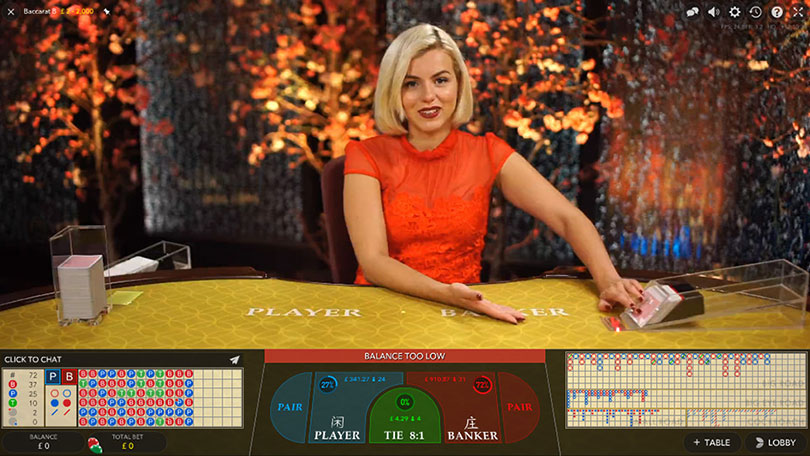
Live dealer baccarat has made the game more accessible. Players can choose standard tables, VIP tables, fast tables, and localized streams. Mobile interfaces also display scoreboards, roads, and shoe history. These tools are useful for tracking your own play, but they do not predict the next result. A strong Baccarat betting systems explained approach uses technology for discipline, not fortune-telling.
RTP/Volatility
Return to player
The Banker bet typically returns about 98.94% over the long run, while Player returns about 98.76%. These figures are excellent compared with many casino games. Tie often returns far less, commonly around 85% to 86% depending on the number of decks and payout. This is why serious baccarat bankroll strategies usually avoid Tie as a core wager.
Baccarat betting systems explained must emphasize that RTP is a long-term average, not a session guarantee. You can win quickly, lose quickly, or hover near even. The RTP only becomes meaningful across a very large number of hands. In a short live dealer session, variance can dominate.
Volatility and bankroll swings
Base baccarat is low to medium volatility when compared with high-variance slots or jackpot games. However, staking systems can transform that experience. A flat bettor risking one unit per hand has controlled variance. A Martingale bettor may suddenly risk 16, 32, or 64 units on a single hand. The game did not become more volatile; the betting pattern did.
The smartest Baccarat betting systems explained framework is to match your unit size to your bankroll. Conservative players may want 50 to 100 units. Recreational players may be comfortable with 30 to 50 units. Aggressive progression players need far more because their bet size can escalate rapidly.
Scoreboards, roads, and pattern myths
Baccarat scoreboards such as the Big Road, Bead Plate, Big Eye Boy, Small Road, and Cockroach Pig are popular in casinos. They help players visualize streaks and chops. They do not change the odds. Each hand is resolved by the shoe composition and drawing rules, not by the pattern drawn on the screen.
That does not mean roads are useless. They can help you stay organized if your system depends on switching between Banker and Player after certain sequences. But if your plan assumes that five Banker wins make Player “due,” you are relying on the gambler’s fallacy. In Baccarat betting systems explained, pattern tracking is a record-keeping tool, not a prediction engine.
Bankroll Management Rules
Set a unit before you start
Your unit should be small enough that a normal losing streak does not pressure you. If losing five units makes you uncomfortable, your unit is too large. Good baccarat bankroll management starts before the first hand, not after frustration appears.
Use stop-loss and win goals
A stop-loss is the maximum you are prepared to lose in a session. A win goal is the amount of profit at which you are willing to quit. For example, you might stop after losing 20 units or winning 10 units. This prevents the common mistake of turning a good session into a losing one.
Keep systems simple
The more complicated your rules, the easier it is to break them. Baccarat betting systems explained for real players should be easy to execute under pressure. Write down your base unit, bet choice, progression rule, stop-loss, and cash-out target. If you cannot explain the system in one minute, it is probably too complex.
FAQ
Q: Can any baccarat betting system guarantee profit?
Q: What is the best bet in baccarat?
Q: Is Martingale good for baccarat?
Q: Should I follow baccarat roads and patterns?
Q: Which system is best for beginners?
Final Verdict
Baccarat betting systems explained properly leads to one conclusion: the strongest advantage a player has is not prediction, but discipline. Banker offers the best standard math, Player remains playable, and Tie should be approached with caution. Flat betting is the most sustainable route, while positive progressions can add excitement without the extreme danger of chasing losses.
If you try Martingale, D’Alembert, Paroli, or 1-3-2-6, treat each as a bankroll style rather than a secret formula. Decide your unit, accept the house edge, avoid side-bet traps, and stop when your pre-set limits are reached. In the end, Baccarat betting systems explained is not about beating the shoe. It is about playing a simple, elegant casino game with realistic expectations and controlled risk.
What Readers Are Saying

Really enjoyed reading this. The real-time stats feature mentioned here really helps with decision-making. Decent guide, covers the basics well.
Exactly what I needed. The live dealer experience here is top-notch. Streamed perfectly with no lag. Worth your time for sure.
Great article! Finally a guide that explains side bets clearly. Very helpful for beginners. Solid 4 out of 5.
Solid write-up. Switched to this platform after reading the review. The dealers are very professional. Decent guide, covers the basics well.
Editorial Review: This guide has been reviewed by the editorial team for clarity, practical value, mobile usability, payment safety, and safer decision-making.